

One of the biggest questions small business owners face is this: what should we post every week?
Many businesses want to stay active on social media, but they quickly run out of ideas. Then the page becomes repetitive, inconsistent, or overly promotional. One week it is only offers. Another week it is only greetings. After that, there is no posting at all.
The problem is not lack of effort. The problem is lack of structure.
In 2026, small businesses need content that does more than fill the page. It should help people understand the business, trust the brand, and stay connected to it regularly. That is why weekly content should follow a balanced mix instead of random posting.
Why weekly content matters
A social media page becomes stronger when it stays active with purpose.
If a business posts only once in a while, people may forget it. If it posts only promotional content, people may ignore it. But when a page shares useful and relevant content every week, it creates familiarity.
That familiarity matters because customers often take time before making a decision. Weekly content keeps your business visible during that time.
It also helps your page look active, reliable, and serious.
A small business should not post only offers
This is one of the most common mistakes.
Many businesses think social media should mainly be used to promote services, products, discounts, and direct selling messages. But if every post is about “buy now,” “call now,” or “best service,” the page starts feeling repetitive.
People do not follow business pages only to see constant selling.
They stay connected when the content gives them value, clarity, trust, or interest. That is why weekly content should include different types of posts, not just promotions.
The best weekly content mix for small businesses
A strong weekly content plan usually includes these five content types:
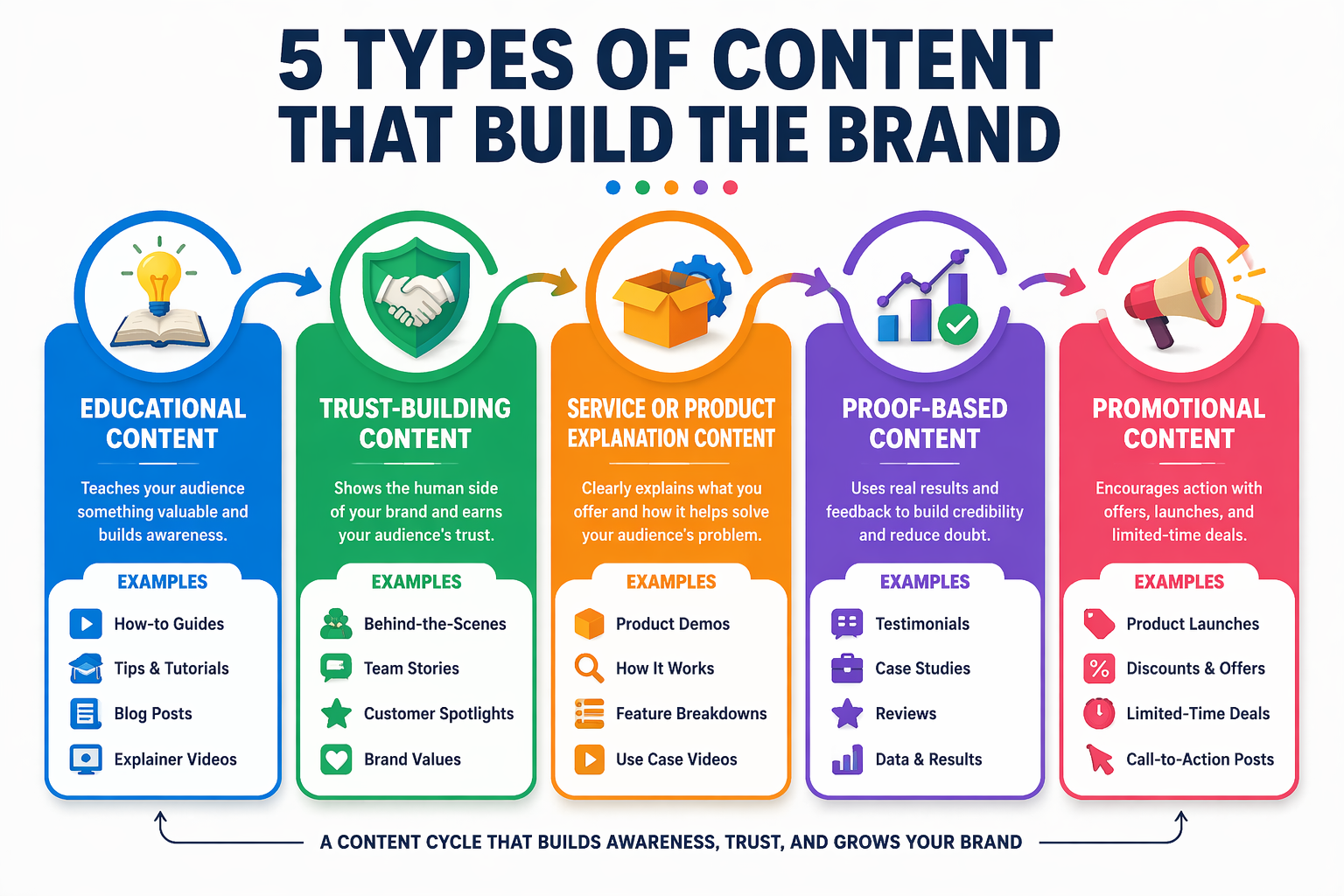
- Educational content
- trust-building content
- Service or product explanation content
- Proof-based content
- Promotional content
This creates balance.
It keeps the page useful without becoming boring. It also helps the business communicate more clearly and professionally.
Educational content
Educational content helps your audience learn something useful.
This can include:
- Tips
- Common mistakes
- Beginner guidance
- Simple explanations
- Answers to customer questions
- Industry-related insights
Educational content is important because it makes your business look knowledgeable. It also gives people a reason to pay attention even when they are not ready to buy immediately.
For many small businesses, this is one of the best content types to post every week.
Trust-building content
People trust businesses that feel real, active, and consistent.
Trust-building content helps create that feeling. It can include:
- Behind-the-scenes moments
- Team updates
- Business values
- Your process
- Thoughts from experience
- Daily work insights
This type of content is useful because it makes your brand feel more human and more credible.
A page with trust-building content does not feel empty or distant. It feels alive.
Service or product explanation content
Many customers still do not fully understand what a business does, even after visiting the page.
That is why businesses should regularly post content that explains:
- What they offer
- How it helps
- Who it is for
- Why it matters
- What problem it solves
This type of content reduces confusion.
It helps your audience understand your value more clearly, which improves the chances of enquiry.
Proof-based content
Proof-based content shows that your business is not just making claims. It is actually doing real work.
This can include:
- Client feedback
- Completed projects
- Before-and-after examples
- Work samples
- Results
- Milestones
- Case highlights
Proof-based content is powerful because it builds credibility.
People may trust your words to some extent, but they trust visible proof much more.
Promotional content
Promotional content still matters, but it should be used in balance.
This can include:
- Offers
- Service promotions
- Limited-time announcements
- Direct calls to action
- Product highlights
The mistake is not using promotional content. The mistake is using too much of it.
Promotional posts work better when they are supported by educational, trust-building, and proof-based content around them.
A simple weekly posting structure
A small business does not need a complicated system to post well every week.
A simple structure like this is enough:
- Monday – educational post
- Tuesday – service or product explanation
- Wednesday – trust-building or behind-the-scenes content
- Thursday – educational or problem-solving content
- Friday – proof-based or promotional content
This gives variety and balance.
It also makes content planning easier because you are no longer guessing every day.
Reuse one idea across the week
Another smart approach is to build multiple posts from one single idea.
For example, if your weekly topic is “why better content matters,” you can turn that into:
- One educational carousel
- One short video
- One trust-based caption post
- One blog article
- One Google Business update
This saves time and keeps your content direction clear.
Small businesses often struggle with consistency because they think every post needs a completely new topic. That is not necessary. One strong idea can produce multiple valuable posts.
How often should a small business post?
There is no single rule for every business, but a good starting point is three to five posts per week.
This is enough to stay visible without creating unnecessary pressure.
What matters more than frequency is consistency. A business that posts four useful posts every week is far better positioned than a business that posts daily for one week and then disappears for ten days.
Steady activity builds stronger trust.
What makes weekly content more effective?
For weekly content to work well, it should be:
- Clear
- Relevant to the audience
- Visually consistent
- Aligned with the business goal
- Useful or trust-building
- Easy to understand
Good content is not only about design. It is also about message, purpose, and timing.
When these elements come together, your weekly posting becomes much more effective.
What small businesses should remember
If you want to keep your page strong every week, remember this:
Do not post just to stay busy.
Post to:
- Educate
- Build trust
- Explain your offer
- Show proof
- Create action
That is what turns a social media page into a real business tool.
A strong business page is not built by posting more content. It is built by posting the right mix of content consistently.
Final thoughts
So, what type of content should a small business post every week?
The answer is simple: a balanced mix of educational, trust-building, explanatory, proof-based, and promotional content.
This mix helps your business stay visible, useful, and professional. It keeps your audience engaged while also guiding them toward trust and enquiry.
In 2026, businesses that post with structure will always look stronger than businesses that post randomly.
The goal is not to create noise. The goal is to create content that supports business growth every single week.
“A small business should follow a balanced content mix—educational, trust-building, explanatory, proof-based, and promotional—to stay consistent and effective. Consistency matters more than frequency, as regular, valuable weekly posts help build trust, visibility, and customer connection. Social media content should not just sell, but educate, build trust, and show proof, turning your page into a strong business tool.”
Need Expert Help?
At Syril Infotech, we help businesses plan smarter weekly content through digital marketing strategy, content planning, branding, and social media support.
Contact us today to build a stronger content system for your business.
Tags: Content Strategy, Social Media Marketing, Small Business, Weekly Content Plan