Many small business owners think running ads is the fastest way to grow. The moment they start a business page, they feel the next step should be boosting posts or launching campaigns.
But that is where many businesses make an expensive mistake.
Ads can help a business grow, but only when the basics are already strong. If the page looks weak, the branding is unclear, the content is poor, or the offer is confusing, ads will not fix the problem. They will only push more people toward a weak business presentation.
In 2026, ads should not be the first step for every business. They should be the step that comes after clarity, trust, and content are already in place.
Why many small businesses run ads too early
A lot of businesses feel pressure to get results quickly.
They want more reach, more leads, and more calls, so they assume ads will solve the problem. But if the business is not ready, paid promotion becomes wasteful.
Some common early mistakes include:
- Running ads with an incomplete profile
- Promoting pages with very few quality posts
- Sending traffic to weak landing pages
- Using unclear messaging
- Advertising before understanding the audience properly
In these cases, the ad is not the real issue. The real issue is that the business tried to scale before building a proper base.
Ads do not replace trust
One of the biggest misunderstandings in digital marketing is thinking that ads create trust automatically.
They do not.
Ads can increase visibility, but trust still depends on what people see after they click. If someone visits your page or website and finds poor branding, unclear service details, low-quality content, or no proof of work, they may leave without taking action.
This is why ads should support trust, not replace it.
Before paying for reach, your business should already look worth noticing.
What should be ready before running ads?
Before a small business starts running ads, some basics should already be in place.
Your business should have:
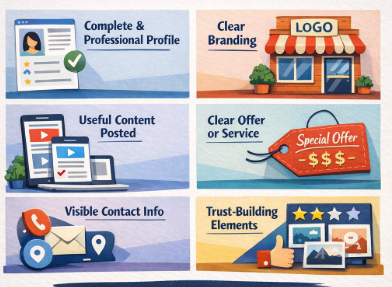
- A complete and professional profile
- Clear branding
- Useful content already posted
- A clear offer or service explanation
- Visible contact information
- Trust-building elements such as work samples, reviews, or strong presentation
- A clear understanding of the target audience
These things matter because ads work better when the page or website already looks credible.
If the base is weak, ad performance usually suffers.
A business should first build organic strength
Before spending money on ads, a business should prove that it can present itself properly through organic content.
That means:
- Active social media pages
- Clear messaging
- Regular posting
- Educational and trust-building content
- Audience understanding
- A professional business image
Organic content helps shape the brand before ads amplify it.
When a page already has useful content and a clear identity, new visitors from ads are much more likely to take the business seriously.
Ads work best when there is already clarity
A small business should start running ads when it can clearly answer these questions:
- Who are we trying to reach?
- What exactly are we offering?
- Why should people choose us?
- What action do we want them to take?
- Where are we sending them?
- Does our page or website support that action properly?
If these answers are not clear, ads become guesswork.
Clarity improves ad performance because it strengthens both the message and the experience after the click.
When ads make the most sense
A small business should usually consider ads when:
- The page already looks professional
- Content is being posted consistently
- The service offer is clear
- There is a landing page or contact path ready
- The audience has been defined properly
- The business wants to speed up visibility or lead generation
This is the right stage for ads.
At that point, paid promotion becomes an amplifier. It increases the reach of something that is already working, instead of trying to rescue something weak.
Signs your business is not ready for ads yet
Some businesses should wait before spending on paid campaigns.
You may not be ready for ads yet if:
- Your page has very few posts
- Your branding is inconsistent
- Your website is incomplete or missing
- Your content does not explain your service clearly
- There is no strong CTA
- You do not know your target audience
- You are hoping ads will “figure everything out”
In these cases, improving the foundation first is the smarter move.
Organic content and ads should work together
It is not organic versus ads. Both matter.
Organic content helps your business build trust, consistency, and authority over time. Ads help you reach more people faster.
The best results usually happen when both work together.
For example:
- Organic content builds trust
- Ads bring targeted attention
- The page or website supports conversion
- Proof and content reduce hesitation
- Follow-up communication turns interest into enquiry
This creates a better growth system than relying only on paid campaigns.
Start small and test carefully
Even when a business is ready for ads, it should not jump in blindly.
A better approach is to:
- Start with a small budget
- Test one clear offer
- Use one clear audience
- Track results carefully
- Improve the message based on performance
Ads become more effective when they are treated as a process of learning and improving, not just spending.
A business that tests carefully will usually make better decisions than one that launches big campaigns too early.
What small businesses should focus on first
Before running ads, focus on:
- Profile quality
- Branding clarity
- Strong content
- Audience understanding
- Trust-building posts
- Service explanation
- Clear CTA and enquiry path
Once these become strong, ads can support growth much more effectively.
That is the right order.
Ads can bring people to your business, but only strong content, clarity, and trust can make them stay interested.
Final thoughts
So, when should a small business start running ads?
The answer is simple: not at the very beginning, and not before the business is ready to convert attention into trust and action.
Ads should come after the foundation is built. When your page looks professional, your messaging is clear, your content is useful, and your audience is understood, then ads can become a powerful tool for growth.
In 2026, smart businesses will not use ads as a shortcut. They will use them as an accelerator after the basics are already strong.
That is how paid marketing becomes more effective and less wasteful.
“Ads should only start after your business has a strong profile, clear branding, quality content, and trust. Running ads with a weak foundation increases reach, but does not bring real results or conversions. The right time for ads is when your audience, offer, and content strategy are clear and consistent.”
Need Expert Help?
At Syril Infotech, we help businesses prepare for growth with better branding, stronger content, smarter digital marketing, and performance-focused ad strategy.
Contact us today to grow your business the right way.
Tags: Paid Ads, Digital Marketing, Small Business, Social Media Advertising